Cheminformatics Toolkits
Programming Libraries for Cheminformatics beyond OEChem
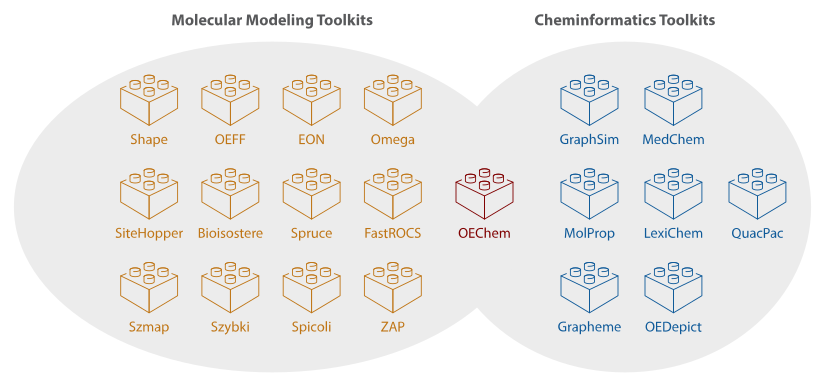
GraphSim TK offers the following fingerprint types to perform 2D molecular similarity measurements: MACCS key, LINGO [1,2], and a highly customizable implementation of path-based fingerprints. Users are allowed to set the fingerprint size as well as various atom/bond types, and can specify the length of the enumerated paths. Six common similarity indices (Cosine, Dice, Euclidean, Manhattan, Tanimoto, Tversky) are available, while user-defined similarity measures are also applicable.
MolProp TK calculates 2D molecular properties and generates custom filters. Calculated properties include: molecular weight, XlogP [3], XlogS, PSA [4], hydrogen bond donor and acceptor count, rotatable bonds, ring size and number, etc. MolProp TK offers ADME filters such as Lipinski [5], Egan [6], Veber [7] and Martin [8]. It also provides graph-based protonation state assignment for consistency and speed.
Lexichem TK provides high conversion rates of chemical structures to chemical names and vice-versa. It also automates foreign language translation of chemical nomenclature [9]. Supported nomenclature: IUPAC 79, IUPAC 93, IUPAC 200x, Chemical Abstracts / CAS, Traditional, Systematic, MDL/Beilstein, AutoNum, OpenEye. Supported langues: English (American, British, International), Japanese, Spanish, Swedish, German, French, Polish, Chinese, Hungarian and Russian.
Ogham TK [10] offers artful 2D rendering of chemical structures. It generates structure diagrams [11] (2D coordinates) suitable for rendering (in GIF, BMP, SVG, or PostScript) from connection tables (e.g. SMILES) or 3D structures. It also comes with example source code for generating JPEG and PNG images as well as integration with Qt. Ogham TK provides consistent (and specifiable) orientation of core substructures and offers a variety of display controls.

[1] Vida, D., Thormann, M., Pons, M., J. Chem. Inf. Model., 2005, 45, 386.
[2] Grant, J.A., Haigh, J.A., Pickup, B.T., Nicholls, A., Sayle, R.A., J. Chem. Info. Model., 2006, 46, 1912.
[3] Wang, R., Ying, F., Lai, L.J., Chem. Info. Comput. Sci., 1997, 37, 615.
[4] Ertl, P., Rohde, B., Selzer, P., J. Med. Chem., 2000, 37, 3714.
[5] Lipinski, C., et. al., Adv. Drug. Deliv. Rev., 1997, 23, 3.
[6] Egan, W.J., Merz, K.M., Baldwin, J.J., J. Med. Chem., 2000, 43, 3867.
[7] Veber, D.F., Johnson, S.R., Cheng, H.Y., Smith, B.R., Ward, K.W., Kipple, K.D., J. Med. Chem., 2002, 45, 2615.
[8] Martin, Y.C., J. Med. Chem., 2005, 48, 3164.
[9] Sayle, R., J. Chem. Inf. Model., 2009, 49, 519.
[10] The Ogham alphabet system of the ancient Irish is represented by lines, hashes and wedges; it is principally known for the inscription of names on standing stones.
[11] Helson, H.E., in "Reviews in Computational Chemistry", 1999, 13, 313—98, Eds. Lipkowitz, K.B, Boyd, D.B., Wiley-VCH Press.