

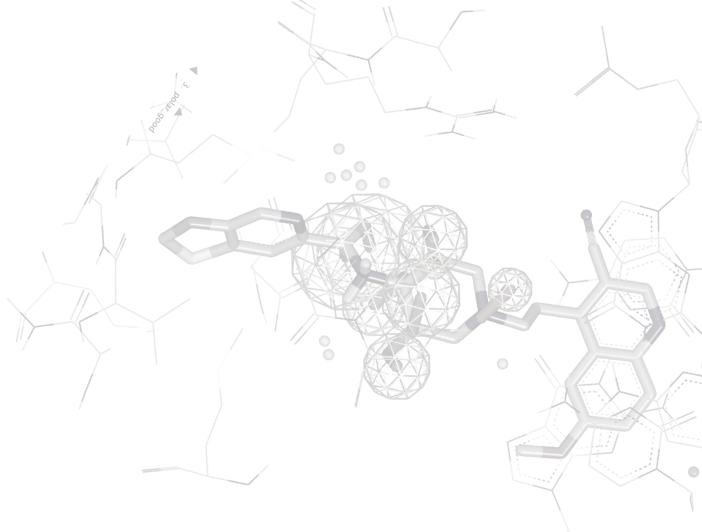
EON
EON is an electrostatics comparison program. It compares electrostatic potential maps of pre-aligned molecules and determines the Tanimoto measures for the comparison.
As the electrostatic potential of molecules is not strongly linked to the molecular graph, EON can screen molecular databases for electrostatic similarity to a lead compound to identify lead-hops.
In particular, the electrostatic comparison program EON has shown promise in identifying leads and tool compounds… -- Boström et al. (J. Med. Chem. 2013)
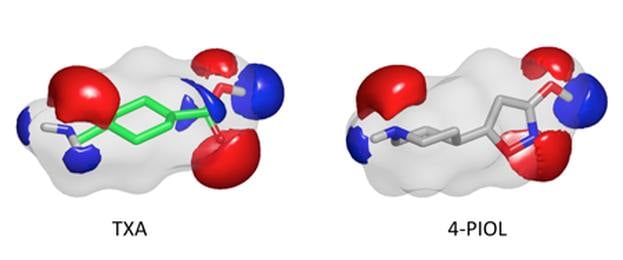
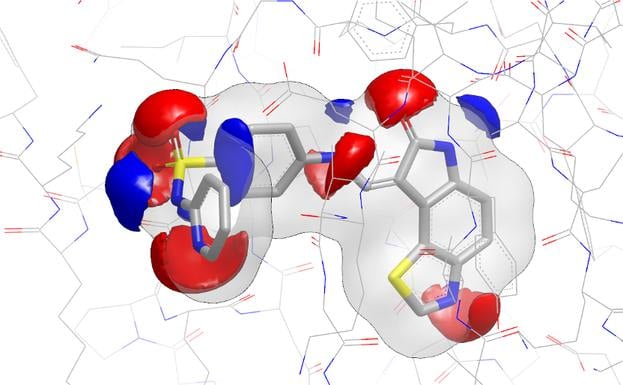
Since the input molecules must already be aligned, EON is suitable for analyzing the output structures from programs such as ROCS, thus yielding compounds with similar shape and electrostatics.
EON contributes significantly to lead generation and library design. In a published study, Abbott scientists reported that EON's post-processing of ROCS hits helped them lead-hop a MCH-1 series that had demonstrated in vivo potency issues [1]. In a chemical genomics project directed toward antagonists for NAADP, EON was used in complement to ROCS to identify a low nanomolar binder to the NAADP receptor [2].
For more detailed information on EON, check out the link below:
Documentation