

Cadence Molecular Sciences (OpenEye) announces the submission of two papers validating its first-in-class protein pocket detection and ligandability model, Target X Pocket Detection and Ligandability Model (Target X)™. Target X combines physical simulation with AI, leveraging experimental structural biology data or computational models to explore potential protein binding pockets.
By revealing previously unknown pockets, or expanding already identified pockets, Target X provides actionable insight for structure-based drug design, efficiently augments the druggable genome, and unlocks difficult-to-drug targets. Improved understanding of binding site flexibility helps project teams build superior IP positions for known targets and reduces time to market for difficult-to-drug targets.
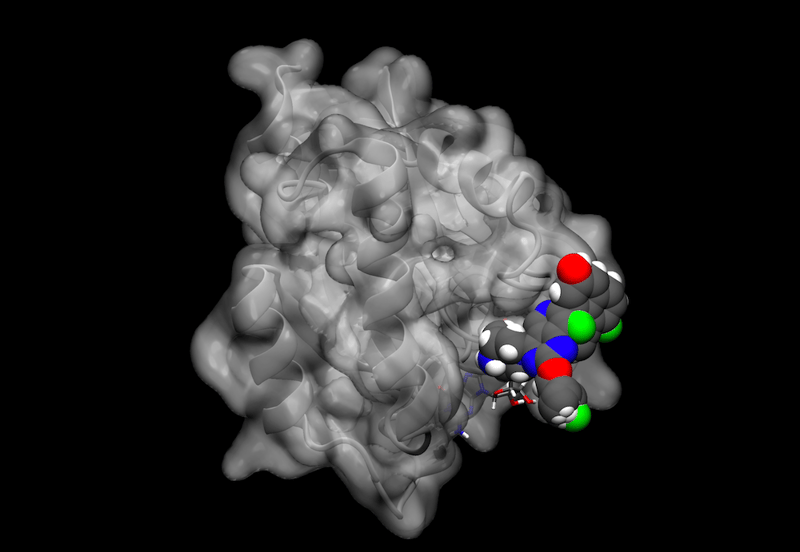
An excellent example of accelerating discovery on a difficult-to-drug target is provided in a 2024 paper on KRAS, a protein involved in around 10% of all human cancers that remained undruggable in spite of 30 years of effort. In cooperation with industrial partners Target X was able to identify a previously unknown pocket in KRAS in less than a day.
Vithani, N. et al. "Exploration of cryptic pockets using enhanced sampling along normal modes: a case study of KRAS G12D." Journal of Chemical Information and Modeling 64.21 (2024): 8258-8273.
weighted Ensemble MD reveals A cryptic Pocket in the presence of a ligand
From a technical perspective, Target X accelerates protein conformational sampling by leveraging weighted ensemble molecular dynamics to simulate the time-scales of protein motion required to reveal protein pockets. Traditional molecular dynamics (MD) methods require days or weeks of computation to achieve the same level of sampling that weighted ensemble simulations achieve in only hours, and preliminary results have shown that traditional MD methods are not able to identify pockets that are discovered by Target X.
To deepen understanding of the method, a dataset of pharmaceutically relevant proteins was assembled with a number of pharmaceutical companies. The first paper in this series of two shows that Target X is over 90% successful in identifying pockets in these proteins that have otherwise proved difficult or impossible to find computationally.
Vithani, N. et al. "Enhanced sampling and ligandability assessment to expand the repertoire of potentially druggable cryptic pockets." (2026).
Accepted in The Journal of the American Chemical Society (JACS)
The second paper in the series focusses on an AI-enabled model to predict the ligandability of pockets generated by Target X’s simulations. The model was built on the largest and most carefully curated dataset ever assembled for this problem, enabling it to achieve a level of robustness unavailable to previous methods.
Vithani, N. et al. "Target X built on Groovy: An unbiased and robust ligandability prediction model built and evaluated on non-redundant, well-curated dataset." (2026).
Under Review
Key findings from this pair of papers are that protein motions that reveal new pockets can be efficiently recapitulated by the Target X method, and that the resulting pockets can be accurately identified for drug design. Therefore, rapidly obtaining information on relevant binding site motion with Target X can substantially accelerate drug discovery programs on new or difficult-to-drug targets as well as on better established targets.
The Target X workflow integrates seamlessly with Cadence’s downstream molecular design tools including ultra-large scale docking and binding affinity prediction, further accelerating the process of identifying potential drugs for any target protein.
Target X is available for all customers with access to Cadence’s Orion® Molecular Design Platform, along with special license provisions for academic and non-profit use.
For more information, please contact oe-sales@cadence.com.