

MolProp TK
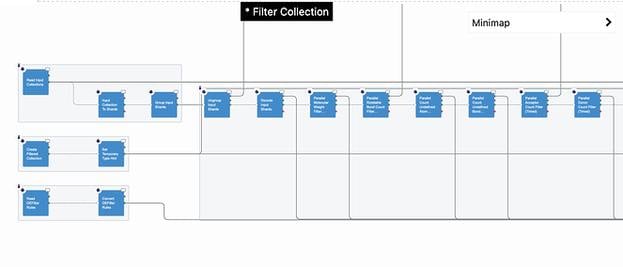
The MolProp TK provides a customizable framework for molecular property calculation geared towards enabling rapid database filtering. Filtering attempts to eliminate inappropriate or undesirable compounds from a large set before beginning to use them in modelling studies.
The goal is to remove all of the compounds that should not be suggested to a medicinal chemist as a potential hit. This exercise is obviously case dependent, depending on ease of the assay, intended target, personal bias of the modeller & medicinal chemist, strengths of the company, etc., which makes this problem one that is highly amenable to a toolkit solution.
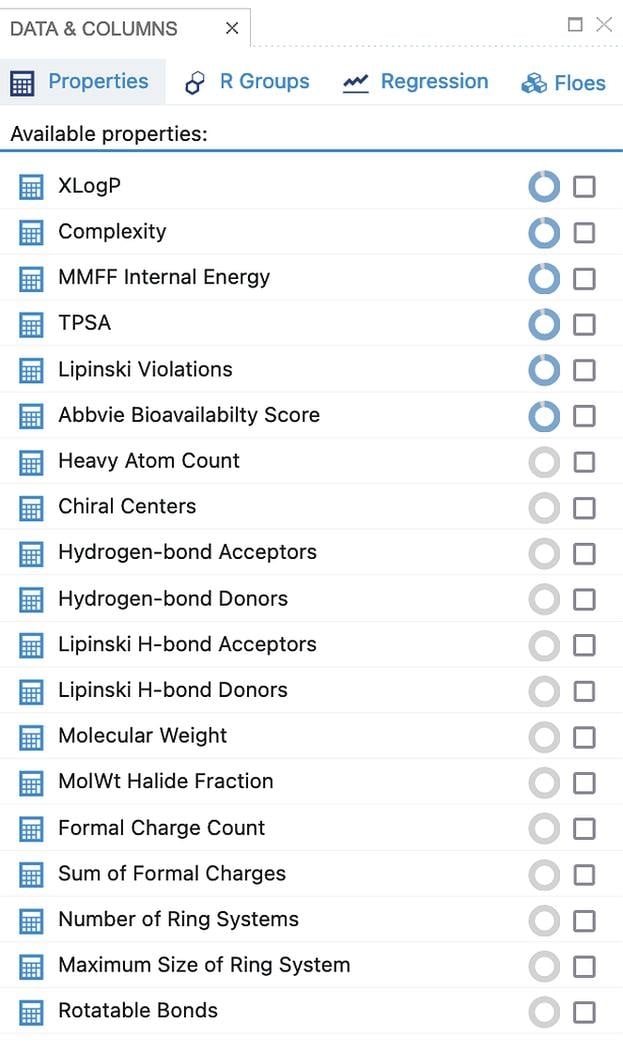
The criteria for passing or failing a given molecule fall into three categories:
Physical properties
- Molecular weight
- Topological polar surface area (TPSA)
- logP
- Bioavailability
Atomic and functional group content
- Absolute and relative content of heteroatoms
- Limits on a very wide variety of functional groups
Molecular graph topology
- Number and size of ring systems
- Flexibility of the molecule
- Size and shape of non-ring chains
Beyond the standard molecular properties available from OEChem TK such as molecular weight and atom type counts, MolProp TK calculates XlogP [1], XlogS, and PSA [2]. There is also a variety of ADME filters available such as Lipinski [3], Egan [4], Veber [5] and Martin [6].
In addition to calculating properties and filtering on those properties, MolProp TK provides a variety of preprocessing tools for metal and salt removal, pKa normalization, normalization, reagent selection and type checking.
For more detailed information on MolProp TK, check out the link below:
Documentation