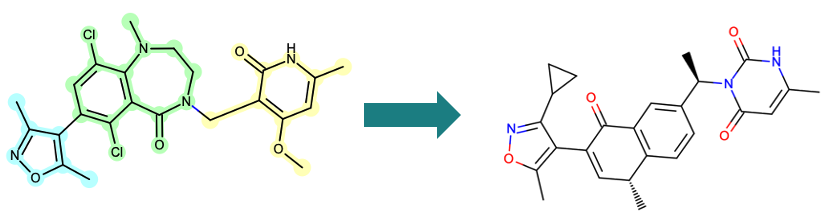
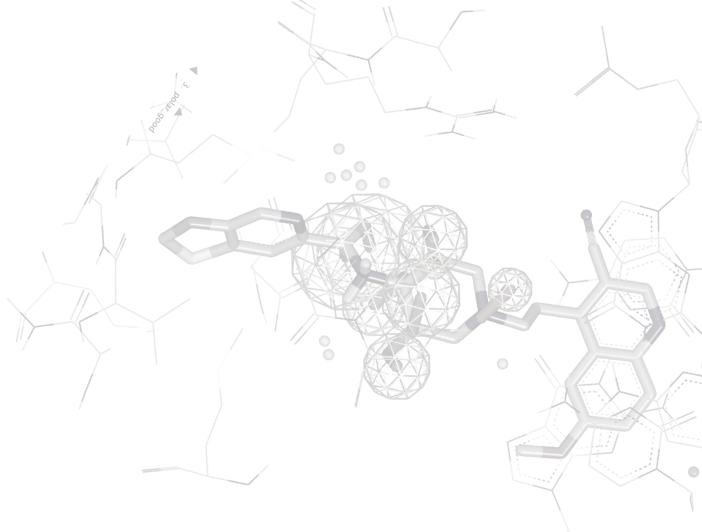
Bioisostere TK
Bioisostere TK generates analogs by fragment replacement, replacing a portion of a lead compound with fragments that have similar 3D properties but potentially novel connectivity and chemistry. To ensure synthetic accessibility of its results Bioisostere TK ships with a database of fragments derived from ChEMBL, while custom databases of fragments can be created from any set of molecules using both pre-defined and tailored rules.
The toolkit provides fragment-based modeling tools, including fragment creation, fragment conformer generation, and fragment alignment and scoring using similarity based on physically meaningful representations: shape, chemical features, and electrostatics.
Bioisostere TK provides programmatic access to the existing BROOD and CHOMP applications.
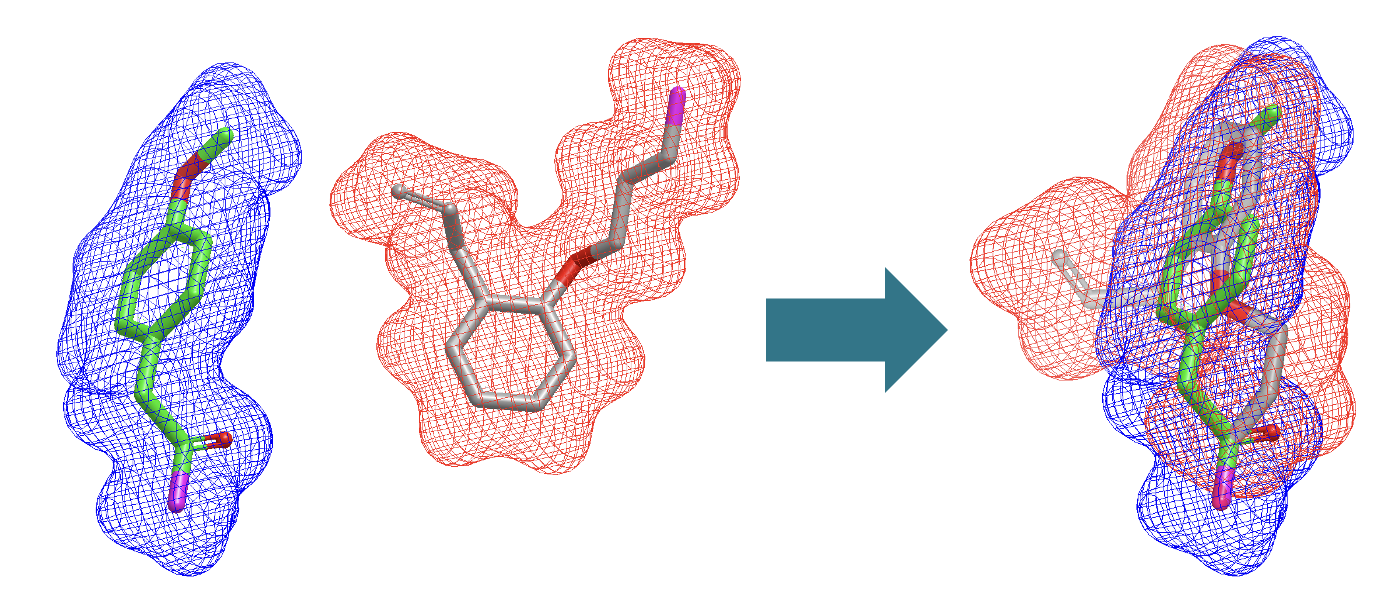
Multi-Query Fragment Replacement
Bioisostere TK enables both single-site and multi-site fragment replacement. The combinatorics of multi-fragment replacement are handled by intelligent scoring and ranking, exploring potentially gigantic molecular spaces efficiently. With no limit on the number of fragments per molecule, Bioisostere TK is a scalable foundation for building generative design applications on the proven science in our 3D similarity tools.

Modeling
The Modeling suite of toolkits provides the core functionality underlying OpenEye's defining principle that shape & electrostatics are the two fundamental descriptors determining intermolecular interactions. Many of the toolkits in the Modeling suite are directly associated with specific OpenEye applications and can, therefore, be used to create new or extend existing functionality associated with those applications.
- OEChem TK OEChem TK Core chemistry, advanced peptide handling, and high-performance molecule file I/O
- FastROCS™ TK Real-time shape similarity for virtual screening, lead hopping & shape clustering
- OEDocking TK Molecular docking and scoring
- Omega TK Conformer generation
- Shape TK 3D shape description, optimization, and overlap
- SiteHopper TK Rapid comparison of protein binding sites
- Spicoli TK Surface generation, manipulation, and interrogation
- Spruce TK Protein preparation and modeling
- Szybki TK Force field based focused optimization and entropy estimations
- OEFF TK Force fields and general optimization tools
- Szmap TK Understanding water interactions in a binding site
- Zap TK Calculate Poisson-Boltzmann electrostatic potentials
- Bioisostere TK 3D fragment similarity, lead optimization, and analog generation
- Eon TK Molecular shape and electrostatic overlap
Cheminformatics
The Cheminformatics suite of toolkits provides the core foundation upon which all the OpenEye applications and remaining toolkits are built.
- OEChem TK OEChem TK Core chemistry, advanced peptide handling, and high-performance molecule file I/O
- OEDepict TK 2D Molecule rendering and depiction
- Grapheme™ TK Advanced molecule rendering and report generation
- GraphSim TK 2D molecular similarity (e.g. fingerprints)
- Lexichem™ TK Name-to-structure, structure-to-name, foreign language translation
- MolProp TK Molecular property calculation and filtering
- Quacpac TK Tautomer enumeration and charge assignment
- OEMedChem TK Matched molecular pair analysis, fragmentation utilities, and molecular complexity metrics
- Saiph TK: Extracting, transforming, and loading (ETL) files and records
Webinar: Own Your Own Target with Target X
Webinar: Improving the Core: Not Resting on Our Laurels
Webinar: Too Hot, Too Cold, or Past Midnight? Statistical Considerations in Lead Optimization from Goldilocks & Cinderella
Webinar: AI For Drug Discovery
Webinar: Modular Molecular Modeling
Webinar: Exploring the Uncharted: Discovery at Trillion-Scale with ROCS X
Resources
View Our Recent Webinars
On Demand Webinars
Webinar: Target X: An Unobstructed View of Pockets
On Demand Webinars
Webinar: Own Your Own Target with Target X